
A2 Medical Services focuses on improving medical education through interdisciplinary learning and advanced technologies.
Key initiatives include:
- Integrated Ayurveda and Modern Medicine learning programs
- Medical workshops and training programs
- AI in healthcare training for doctors and researchers
- Clinical research methodology training
- Digital health and telemedicine education
The aim is to develop future-ready healthcare professionals capable of practicing integrated medicine.
Medical education Practical Entrance Exam Prep Tools
Mock Test Series: Computer-Based Tests
The core of the entrance exam centers on classical texts.
Training should focus on:
Charaka Samhita: Internal medicine (Kayachikitsa) and fundamental principles.
Sushruta Samhita: Surgical techniques (Shalya Tantra) and anatomy (Rachana Sharir).
Ashtanga Hridaya: Integration of the best of both worlds for daily practice.
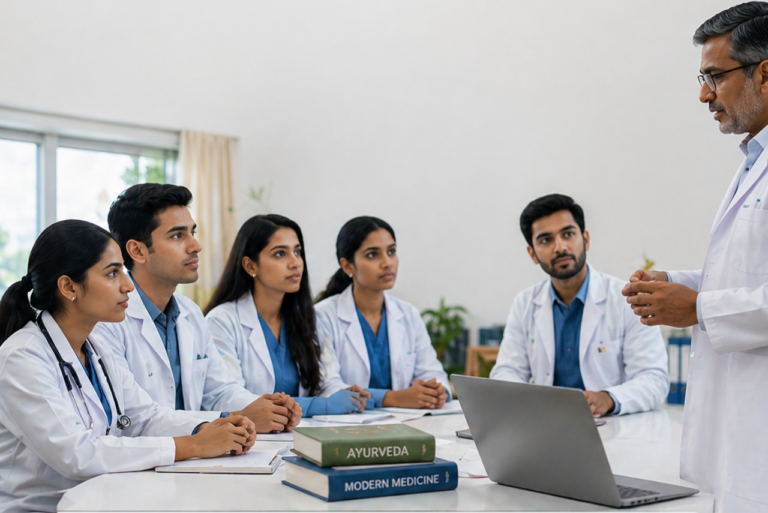
Integrating Artificial Intelligence (AI) with Ayurveda represents a powerful shift from traditional practice to “Evidence-Based Ayurveda.” By combining the ancient wisdom of the Vedas with modern machine learning, we can standardize treatments, personalize wellness, and validate Ayurvedic efficacy on a global scale.
1. Core Applications of AI in Ayurveda
Prakriti Identification (Personalized Phenotyping)
One of the hardest parts of Ayurveda is accurately determining a person’s Prakriti (Dosha balance: Vata, Pitta, Kapha).
Computer Vision: AI models can analyze facial features, tongue color, and skin texture to assist in Prakriti assessment.
Voice Analysis: AI can analyze the tone, pace, and pitch of a patient’s voice, which traditionally correlates with specific Doshas.
Nadi Pariksha (Pulse Diagnosis) Digitization
AI-driven sensors can capture the subtle pressure waves of the radial pulse. Machine learning algorithms then compare these waveforms against thousands of recorded patterns to provide a more objective “Digital Nadi Pariksha.”
Standardizing “AgriMedTech”
AI plays a massive role in the cultivation of medicinal plants (Dravyaguna):
Precision Farming: IoT sensors and AI monitor soil health and climate to ensure medicinal plants reach their maximum bioactive density.
Quality Control: AI-powered spectral imaging can identify adulterated herbs or heavy metal contamination in raw materials instantly.
2. Bridging the Research Gap
The biggest challenge for Ayurveda has been the lack of large-scale clinical data. AI changes this:
Predictive Modeling: By analyzing the chemical composition of herbs (Rasashastra), AI can predict how certain formulations will interact with specific human proteins, speeding up drug discovery.
Predicting Side Effects: AI can help practitioners understand how Ayurvedic treatments might interact with modern pharmaceuticals (Integrative Medicine), ensuring patient safety.
Statistical Validation: Using Bayesian methods and regression models, researchers can track student learning growth in Ayurvedic colleges or patient recovery rates in clinics.
A clinical “Co-pilot” for practitioners that suggests treatment protocols based on classical texts and modern diagnostic reports